


Georgia is one of the oldest wine countries in the world. Wine has been made here for thousands of years. The country has seven main wine regions, each with its own climate, its own grape varieties and its own wine culture, from sunny, dry Kakheti in the east to the humid, subtropical coast of the Black Sea.
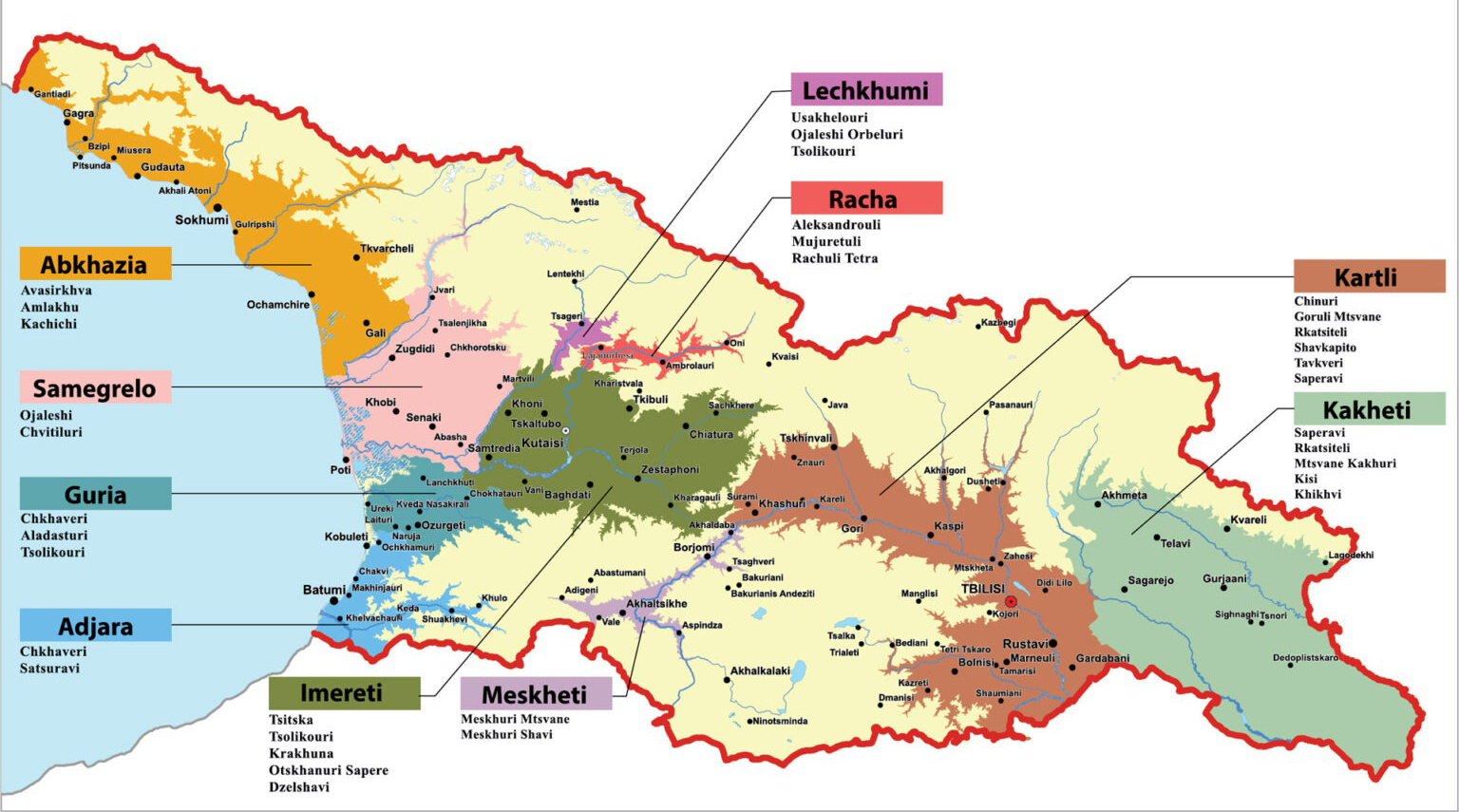
The Likhi Range, a spur of the Caucasus, divides Georgia into a drier east and a wetter, milder west. You can taste that difference in the wine. The regions also have different traditions. Everywhere, alongside ‘ordinary’ wine, wine is made in qvevri: huge earthenware ‘pots’ buried in the winery's cellar.
In eastern Georgia, and especially in Kakheti, white grapes traditionally ferment for months (often around six months) on their skins in qvevri. This produces firm, amber-coloured wines. In the west of the country, for example in Imereti, the qvevri is called a ‘churi’ or ‘lagvani’ and skin contact is much shorter, so the wines are lighter and fresher.
The wine region of Kakheti, in the far east, is by far the most important in the country: more than two thirds of all Georgian wine comes from here. Its heart is the valley of the Alazani river, between the Greater Caucasus to the north and the Tsiv-Gombori range to the south. Kakheti has more designations of origin than any other region. On the left bank lie Kvareli, known for dry red Saperavi, and Kindzmarauli, Georgia's most famous semi-sweet red wine, among others. On the right bank lie Tsinandali, the classic dry white wine from Rkatsiteli and Mtsvane, and Mukuzani, a powerful, deeply coloured Saperavi. Alongside large wineries, hundreds of small family businesses make their own wine here, often in qvevri.
The wine region of Kartli lies around the capital Tbilisi and is the historic heart of Georgia. In terms of volume Kartli is dwarfed by Kakheti, but a lot of interesting things are happening here. Winemakers are bringing neglected Soviet vineyards back to life and rediscovering forgotten grapes such as Chinuri, Goruli Mtsvane, Tavkveri and Shavkapito. Kartli has two designations of origin: Bolnisi in the south, where Swabian settlers made wine in the nineteenth century, and Ateni in the north-west, known for the naturally sparkling Atenuri.
The wine region of Imereti in western Georgia is the country's second-largest and probably most varied. The climate is humid and tempered by the Black Sea. The wine is made in the churi with short skin contact, producing light, fresh wines. White grapes such as Tsolikouri, Tsitska and Krakhuna set the tone. Red grapes range from the powerful Otskhanuri Sapere to lighter varieties such as Dzelshavi and Aladasturi.
The wine region of Racha-Lechkhumi lies high in the mountains of the north-west, along the upper reaches of the Rioni river. Racha is famous for the semi-sweet red Khvanchkara from Aleksandrouli and Mujuretuli, Lechkhumi for the semi-sweet white Tvishi from the Tsolikouri grape. Today more and more winemakers are showing that excellent dry wines can also be made here, often from forgotten varieties such as Rachuli Tetri.
The wine region of Samegrelo, also known as Mingrelia, lies between the Black Sea and the mountains of Svaneti. In the nineteenth century the fresh red and white wines from this area were very popular, but fungal diseases, phylloxera and the Soviet tea and fruit plantations put an end to that. A small group of enthusiasts is now trying to revive winegrowing.
The wine region of Guria lies on the Black Sea, between Samegrelo and Adjara, and is the wettest region in Georgia. It has always been a modest wine area without large wineries. Guria is best known for light, lively red wines with fresh acidity, from indigenous grapes such as Chkhaveri, Ojaleshi, Jani and Skhilatubani. A small group of growers is trying to put the region back on the map by combining old knowledge with modern insights.
The wine region of Adjara lies in the far south-west, against the Turkish border, with the coastal resort of Batumi as its best-known city. Because of the long Ottoman rule, winegrowing only really took off here in Soviet times. The main grape is Tsolikouri. The red Chkhaveri grape is mainly made into light, off-dry rosés. Adjara also has its own indigenous grape, Satsuravi.
Anyone wanting to get to know Georgian wine usually starts in Kakheti. But it is the smaller regions that show how varied the country is: from amber qvevri wine and powerful Saperavi in the east to light, fresh red wines from the west and semi-sweet classics from the mountains of Racha.


 Orange wine (27)
 Fresh (92)
 Light (40)
 Rosé (8)
 Aromatic (21)
 Medium (98)
 Sparkling (21)
 Ripe (71)
 Full-bodied (99)