


Spain has more than twenty wine regions, from the world-famous Sherry of Andalusia to the powerful red wines of Ribera del Duero and La Rioja. An enormous diversity of climates, grapes and wine styles on the world's second-largest area under vine.
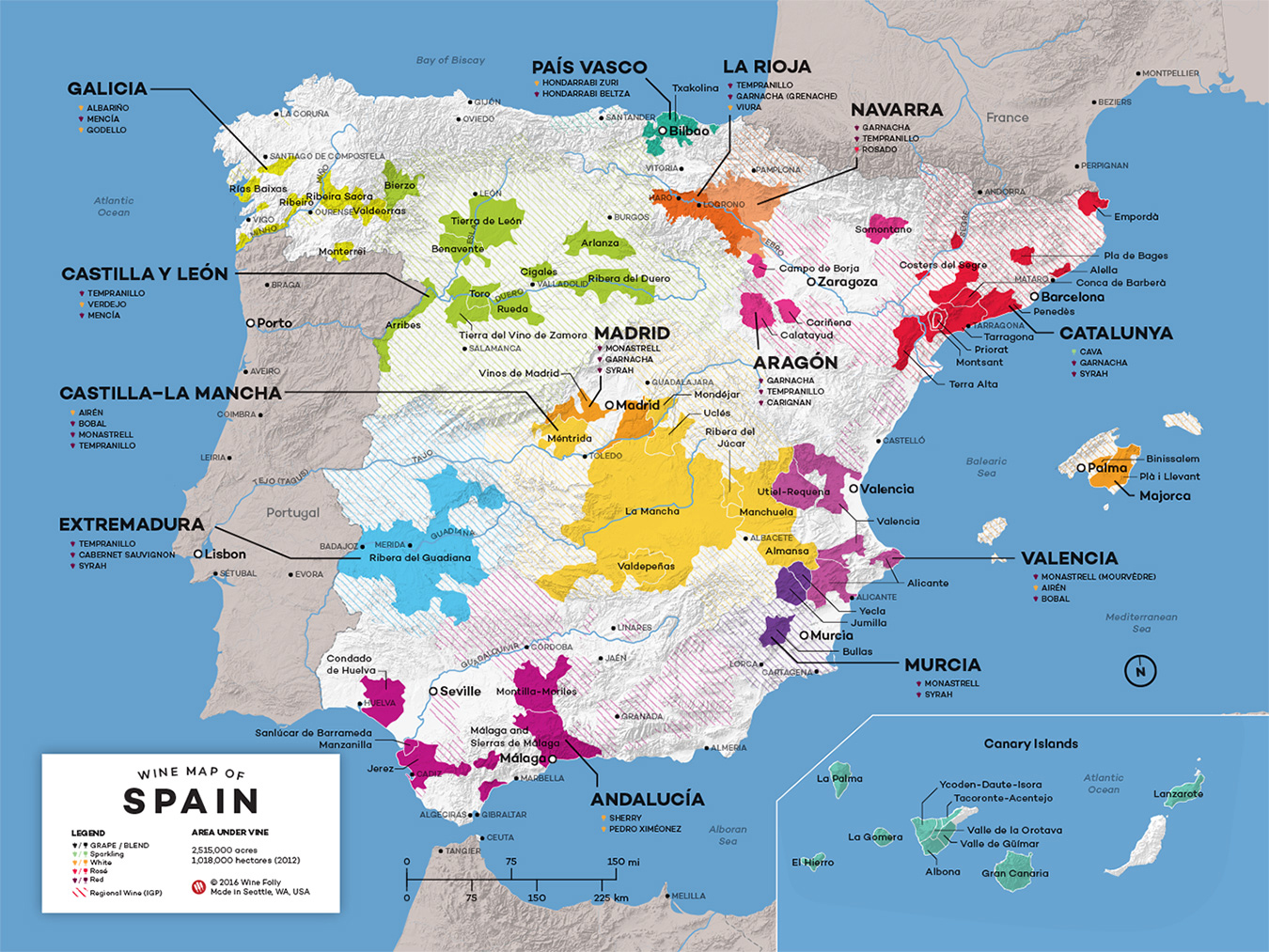
Below we describe the main Spanish wine regions in alphabetical order. In the text you will find links to pages with more information about the various wine regions.
The Andalusia region is the producer of one of the world's best-known wines: Sherry, a widely drunk quality wine for centuries. Its characteristic taste has to do with the wine's long and special ageing process. But Andalusia offers far more than Sherry – in Málaga and Granada, for example, very interesting 'ordinary wines' are made.
The Spanish Aragón wine region lies in the northeast of the country, from the Pyrenees to central Spain. The north is green; in the south, winemakers deal with short, hot summers and cold winters. The wines from Aragón are on the rise, largely thanks to the inventive winemakers of the northern Somontano.
The Basque Country is one of the smallest wine regions in Spain. Fresh white Txakoli wines are made here from the native Hondarribi Zuri grape. Production is low and exports virtually nil – which is exactly what makes it a great destination for adventurous wine drinkers.
On Mallorca, Menorca and Ibiza you can not only sunbathe, you can also taste wine from local winemakers. Together they form the Spanish Balearic Islands wine region. Mallorca is the best choice: decent wine is made here, which mostly never leaves the island.
Viticulture on the Canary Islands began as early as the 15th century, when Spanish and Portuguese explorers were happy to take a cask with them. There are nine DOs on the islands; the most distinctive are Tenerife and Lanzarote. Volcanic like the other islands, but still covered in a layer of grey-black volcanic ash.
The vineyards of the Spanish Castilla y León wine region lie high, at 500 to 900 metres. The soil is poor and the climate extreme, with short, harsh winters and long, dry summers; late frosts into spring threaten the harvest every year. The grapes must fight for every drop, which makes their juice rich and concentrated.
Spain's Ribera del Duero, essentially an extension of the Portuguese Douro valley, has undergone a spectacular transformation. Thirty years ago, only a single cooperative and a handful of wineries were active there; today there are almost 200 modern bodegas producing modern quality wines.
The Rueda region lies slightly west of Madrid, towards the Portuguese border. It is a district within the Castilla y León region, but unlike elsewhere in Castilla y León, Rueda produces almost exclusively white wine – not only from Verdejo, but Sauvignon Blanc also does excellently here.
The Toro region lies some 40 kilometres from the Portuguese border in Castilla y León, along the river Duero. It is a very old wine region that has only in recent years come back into the spotlight, thanks to a local, thick-skinned variant of Tempranillo that produces powerful, fruity red wines here.
The Catalonia region is one of the most exciting wine regions in Spain. Not only because this is where sparkling Cava comes from, but above all because winemakers here have rapidly modernised their operations in recent years and are not afraid of bold experimentation.
Since the end of the nineteenth century, sparkling Cava has been made in Catalonia – in Penedès, to be precise. The Catalans literally copied the method from Champagne and to this day do it exactly like their French counterparts, although they use different grapes. But Penedès is more than Cava: it is a region where dozens of innovative winemakers have settled who also produce excellent still wines.
The Priorat region is a rather forbidding area, wedged between rugged mountain ranges. The Romans already made wine here, but Priorat's revival did not come until the 1980s. Today, very powerful and complex wines are made here, mainly from the Garnacha grape.
The Extremadura region, in western Spain against the Portuguese border, is one of the least-known wine regions in the country. A large agricultural zone where all sorts of crops are grown, including grapes – which mostly end up in uninteresting bulk wines. Of course there are exceptions, but you need to know exactly where to look.
Until a few years ago, Galicia, north of Portugal on the Atlantic coast, barely registered on the wine map. That has changed rapidly in recent years: today Galicia stands for modern, fresh and aromatic white wine. This is largely down to new legislation prescribing the use of quality grape varieties, with Godello and Albariño leading the way.
The La Mancha region, the land of Don Quixote, is a large, dry and hot plain south of Madrid. The winemakers here do not have to fight windmills: La Mancha offers excellent conditions for making decent wine, which keeps prices down. In the past it mainly produced bulk wine, but that is now only partly true – La Mancha is a hotbed of experimentation among talented, innovative young winemakers.
Wine has been made in La Rioja since antiquity. Monks who made pilgrimages to Compostela in the Middle Ages refreshed themselves with red Rioja and spread the region's fame across Europe. But the real breakthrough came in the 19th century, when Bordeaux was ravaged by the phylloxera epidemic: French wine merchants crossed the Pyrenees and taught the winemakers of La Rioja how to age their wine in small oak barrels. They still do so to this day.
Once the vines grew right into the neighbourhoods of the Spanish capital; today they curl around the city at a respectful distance. The small wine region has a typical inland climate with hot, dry summers and moderate frost in winter, and is in practice an extension of the vast La Mancha wine region. Some slightly nutty white wines are made from the Malvar grape, but most of the wine from Madrid is red or rosé.
The vineyards around Murcia are largely planted with Monastrell (Mourvèdre). Murcia used to be a supplier of bulk wines; that is changing. Today the region is experimenting energetically with fairly powerful, expressive red wines – with good results.
The small southern Spanish region of Yecla is an up-and-coming wine area. Sheltered by mountains, its dry vineyards are producing more and more fine quality wines, which are also (still) very affordable. Typical of Yecla are the spicy wines made from the Monastrell grape.
The northern Spanish Navarra wine region borders La Rioja and has traditionally been known for its fruity rosé. In recent years there has been considerable modernisation: ambitious winemakers have planted new grape varieties and are focusing on powerful red wines with a fine structure and velvety tannins.
A third of all Spanish wine is made in the area around Valencia. Most of the wine is exported; in the past its quality sometimes left something to be desired, but that has changed in recent years. Alongside large bulk producers, young winemakers are now active – from the Bobal grape, for example, some rather good red wines are made in Valencia.


 Orange wine (27)
 Fresh (92)
 Light (40)
 Rosé (8)
 Aromatic (21)
 Medium (98)
 Sparkling (21)
 Ripe (71)
 Full-bodied (99)