


Italy has more wine regions than any other country: from the iconic Barolo and Brunello to thousands of little-known native grape varieties. A patchwork of climates and traditions, from the Alps to Sicily.
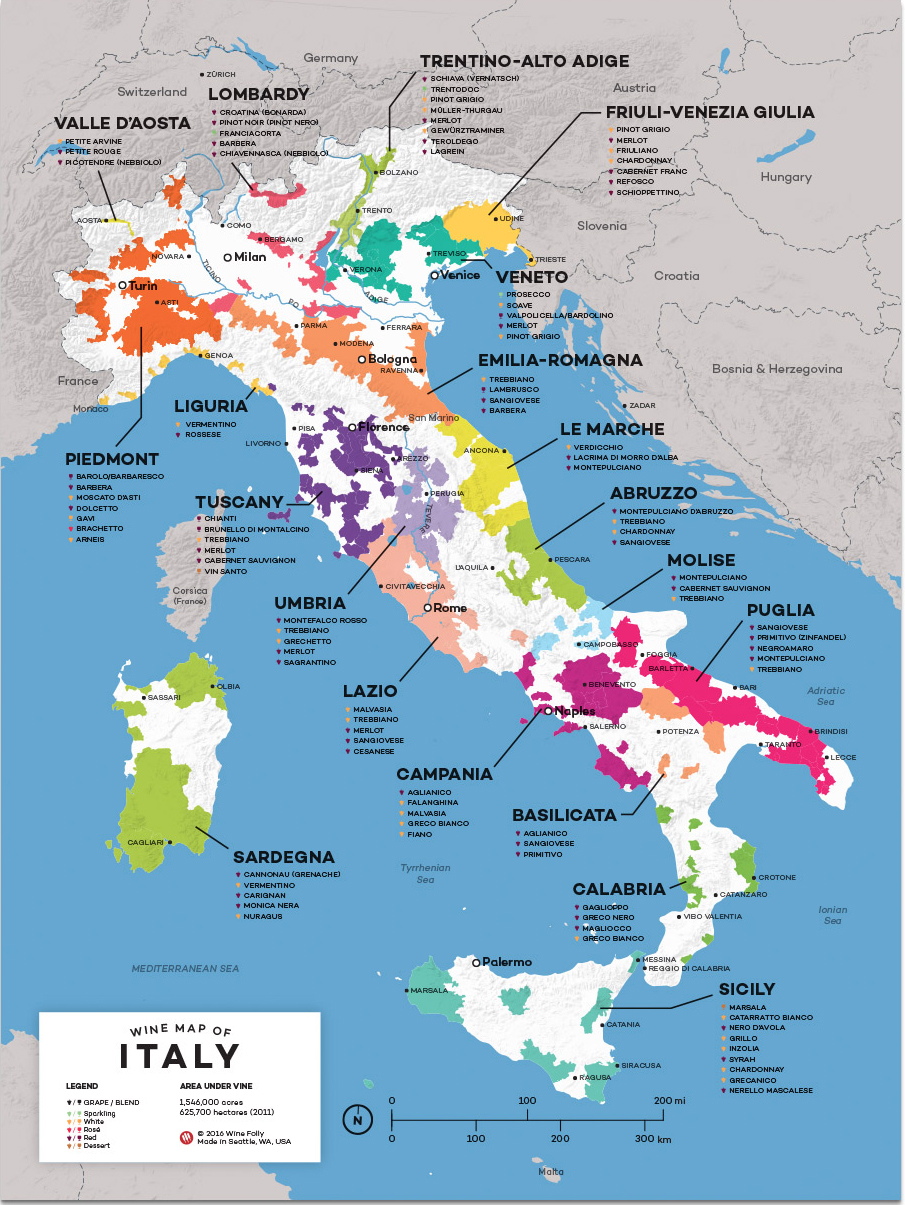
Below we describe the main Italian wine regions in alphabetical order. In the text you will find links to pages with more information about the various wine regions.
The Abruzzo region is a small, rather little-known Italian wine region. Its reputation is due mainly to Montepulciano d'Abruzzo, a pleasant red wine made from the Montepulciano grape. Most white wine from Abruzzo is made from Trebbiano and is best suited to a weeknight glass.
The Alto Adige region – or South Tyrol – belonged to Austria until the First World War, and that is still evident in everything. German is still spoken, and wine is made from 'Austrian grapes' such as Blauburger, Gewürztraminer and Müller-thurgau. But the most important grapes of this mountainous region, Lagrein and Vernatsch, are really only found in Alto Adige.
The Basilicata region is a small wine region in southern Italy. The vineyards lie on the steep slopes of extinct volcanoes. Plenty of table wine is pressed here; no more than 2% of the wine from Basilicata may carry DOC status. The best-regarded wine is Aglianico del Vulture, a red wine from the Aglianico grape.
The Calabria region is a small, rather little-known wine area in the southern 'toe' of the Italian boot. A poor region, where winemakers struggle to gain international recognition for their bottles. That is why it is mainly Italians themselves who enjoy fine wines such as Cirò and Greco di Bianco from Calabria.
The Campania region is the southern Italian wine region around Naples on the coast. Wines are made from characteristic grapes such as Aglianico and Greco di Tufo, grown on the volcanic slopes of Vesuvius, but also on beautiful islands such as Capri and Ischia. Campania was once the most important wine region of the Roman Empire – an achievement its winemakers would love to match again.
The Emilia-Romagna region runs from Piacenza, just below Milan, to San Marino on Italy's east coast. It is one of the country's largest wine regions: the vineyards of Lambrusco, but also of modern natural wines.
The Friuli region lies in the far northeast of Italy, against the border with Austria and Slovenia. The winemakers of Friuli are among the most forward-thinking in Italy – they were the first to put just a single grape variety in the bottle, such as Refosco or Pignolo, grape varieties found nowhere else in Italy.
Once the Roman emperors drank the wines of Lazio, from the vineyards around Rome. Today, mainly white wine is made in Lazio – a lot of bulk wine, but also some rather good wines from a handful of fine wineries. Red wines from French grape varieties are on the rise in Lazio.
The Liguria region is a small but lovely Italian wine area on the Gulf of Genoa, where time seems to have stood still: small-scale winemakers make wine there just as their great-grandfathers did. They are not very well known and exports are limited. But with more than 100 native grape varieties and fine traditions, Liguria has much to offer adventurous wine drinkers.
The Lombardy region, in the Milan-Bergamo-Brescia triangle, has traditionally been mainly a producer of grapes that are pressed into wine elsewhere and served in Milan's cafés – usually not the most exciting wines. But there are two important exceptions: the sparkling Franciacorta and the fine red wines from the Nebbiolo grape from Valtellina.
The Marche region, halfway down Italy's Adriatic coast, was never exactly the most spectacular wine region in the country and for years received little recognition beyond its own borders. That has changed in recent years: red wine from the Montepulciano grape and white wine from Verdicchio and Pecorino from Marche can achieve good to excellent quality.
In terms of area, Molise may be one of Italy's smallest wine regions, yet a fair amount of wine is pressed there. Unfortunately it is rarely interesting enough to be exported – so you do not often see wine from Molise on the shelves of the Dutch wine merchant.
The Piedmont region, in the northwest of Italy, has become famous above all thanks to two iconic wines: Barolo and Barbaresco, powerful red wines from the Nebbiolo grape that can age for a long time. The popular Barbera d'Alba and Moscato d'Asti also come from Piedmont, alongside dozens of lesser-known wines eagerly snapped up by enthusiasts from the wine merchant's shelves.
The vineyards on the rolling hills of Roero and Langhe, around the town of Alba, are above all a pilgrimage site for lovers of the world-famous Barolo and Barbaresco. Alongside these iconic wines, the region also produces red wines from Barbera and Dolcetto, and white wines mainly from Arneis and Favorita.
The hills around Monferrato were once small islands in the Adriatic Sea. Today they are vineyards producing one of Italy's most sought-after apéritif and dessert wines: Moscato d'Asti, a gently sparkling wine with a lush perfume of nutmeg and orange blossom. Red wine in Monferrato is made mainly from the Barbera grape.
In the north of Piedmont, the vineyards lie in the river valleys of the Sésia and the Dora Baltea. Here the renowned Nebbiolo grape reigns. For a long time these were Piedmont's most famous vineyards, until they were overtaken at the end of the last century by Barolo and Barbaresco. Only the very best winemakers still manage to rival these giants.
The Puglia region – or Apulia – is one of the largest grape producers in Italy. Not one of the largest wine producers, mind you, since only a quarter of the grapes end up as wine in a bottle; the rest is distilled or ends up as grape concentrate. Puglia is a region you have to search a little in, but where you can still find characterful red wines offering good value for money by Italian standards.
The Sardinia region is a paradise island for adventurous wine drinkers. Dozens of forgotten grape varieties grow here, their wine rarely reaching the mainland. The vineyards are scattered across the island and most winemakers are small-scale and artisanal, producing no more than a few hundred hectolitres a year.
On Sicily, a true wine revolution has been underway for 25 years. It used to be a forgotten wine island clinging to the faded glory of Marsala. Today, surprising quality wines are made from grape varieties typical of the island, such as the dark-skinned Nero d'Avola and Frappato and the white Inzolia.
The Tuscany region is not only a wonderful holiday destination, it is also one of the most important suppliers of Italian quality wines. Chianti, Vino Nobile, Brunello and of course the 'Super Tuscans' all come from Tuscany's beautiful, rolling vineyards, the cradle of the Sangiovese grape.
Brunello di Montalcino: it is a byword for the wine connoisseur. Robust red wines from the Sangiovese grape from the commune of Montalcino in Tuscany, which can lie for years before reaching their peak, but reward patience with a lush spiciness and ripe notes of sweet tobacco.
The lovely town of Montepulciano in Tuscany is internationally famous for its Vino Nobile di Montepulciano, a wine that, like Chianti, is based on the Sangiovese grape. But Vino Nobile tastes different: firmer and fruitier, thanks to the volcanic soil and the hot, dry summers.
The Trentino region lies in the north of Italy, between the Dolomites and Lake Garda. Mainly fresh, fruity white wines are made from Chardonnay and Pinot Grigio, most of them sparkling. But Trentino also has lesser-known wine treasures, such as red wine from Marzemino and Teroldego grapes.
The Umbria wine region, in the centre of Italy, is best known for the white Orvieto wines made here. Although it does not rank among Italy's top regions, that does not stop it from producing remarkable wines, such as Sagrantino di Montefalco.
The small Italian Valle d'Aosta wine region is a paradise for adventurous wine drinkers. In Europe's highest vineyards, on steep mountain slopes, forgotten native grape varieties such as Petit Rouge and Petite Arvine grow, from which remarkable, characterful wines have been made for centuries.
The Veneto region is one of the most productive wine regions in Italy. Veneto stretches from Lake Garda past Venice to the Adriatic coast. Besides an impressive quantity of mediocre white wines, this is where imposing Amarones, fruity Valpolicellas, sparkling Proseccos and crisp Soaves are pressed. The best wines come from the west, from the vineyards around Verona.


 Orange wine (27)
 Fresh (92)
 Light (40)
 Rosé (8)
 Aromatic (21)
 Medium (98)
 Sparkling (21)
 Ripe (71)
 Full-bodied (99)